
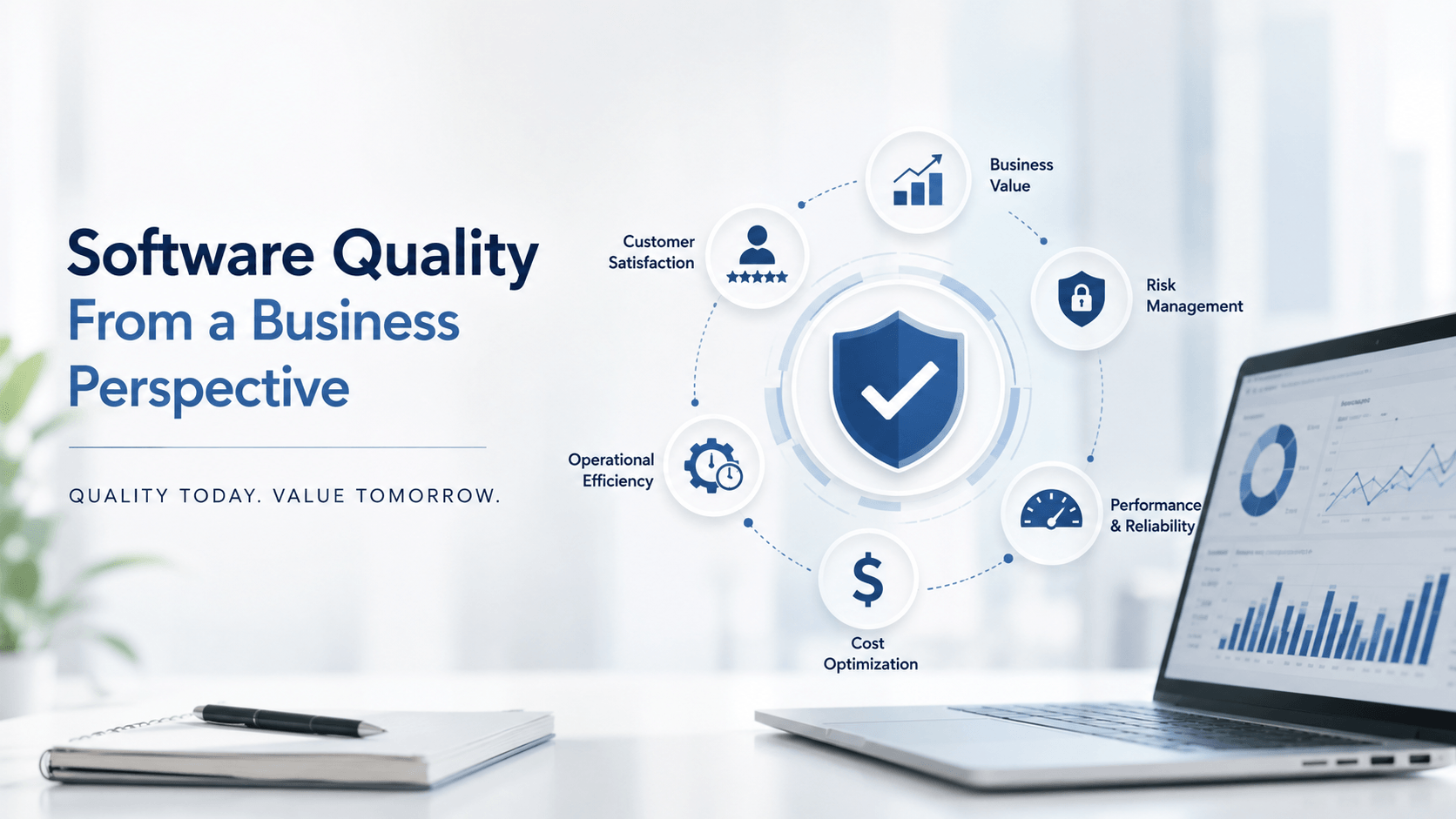
Software Quality from a business perspective
In boardrooms across industries, conversations about digital transformation, competitive advantage, and customer experience dominate strategic planning sessions. Yet one critical element often remains confined to engineering teams and project management dashboards: software quality.
This disconnect represents a significant missed opportunity. Organizations that treat quality assurance as merely a technical checkpoint—rather than a strategic business imperative—face consequences that extend far beyond bug counts and test coverage metrics. The business impact of software quality manifests in customer retention rates, brand reputation, operational efficiency, and ultimately, the bottom line.
As enterprises accelerate digital initiatives and software becomes increasingly central to value delivery, the question is no longer whether quality matters, but rather: how should leadership teams position quality within their broader business strategy?
The Real Cost of Poor Software Quality: Beyond Bug Fixes
When executives think about software defects, they often envision developers fixing code or customers reporting isolated issues. This narrow view dramatically underestimates the true cost of poor software quality.
Financial Impact: The Multiplier Effect
Research consistently demonstrates that the cost of fixing a defect increases exponentially as it moves through the software development lifecycle. A bug identified during requirements analysis might cost $100 to address. The same bug discovered during testing could cost $1,500. If that defect reaches production, the cost escalates to $10,000 or more—not including the cascade of consequences that follow.
These direct remediation costs, however, represent only the visible portion of the impact. The hidden costs include:
- Revenue loss from system downtime or degraded functionality
- Productivity drain as internal teams work around system limitations
- Customer acquisition costs multiplied by increased churn rates
- Technical debt accumulation that constrains future innovation
- Opportunity costs as engineering resources focus on firefighting rather than strategic initiatives
For mid-size and enterprise organizations, these hidden costs can easily dwarf the direct expense of quality issues by a factor of 10 to 1 or more.
Brand and Reputation Damage: The Amplification Era
In an environment where a single customer complaint can reach millions through social media, the reputational impact of quality failures has intensified dramatically. A security breach, data loss incident, or high-profile system failure doesn’t just affect current customers—it creates a persistent digital record that influences prospects, partners, and investors for years.
Consider that 88% of consumers research products online before purchasing. What they find when searching for your brand increasingly includes third-party reviews, social media discussions, and news coverage—all heavily influenced by software quality experiences. A pattern of quality issues creates a narrative that even substantial marketing budgets struggle to overcome.
Competitive Disadvantage: When Quality Gaps Widen
Markets move quickly, and software quality directly impacts competitive positioning. Organizations with poor quality experience:
- Slower time-to-market as releases are delayed for defect remediation
- Reduced innovation capacity as resources address legacy system issues
- Customer migration to competitors offering more reliable experiences
- Talent retention challenges as skilled professionals seek better engineering environments
The compounding effect creates a widening gap between organizations that treat quality strategically and those that view it as a technical afterthought.
From Reactive Bug Fixing to Proactive Software Quality Strategy
The traditional approach to quality assurance—testing applications before release and fixing identified defects—represents a reactive posture that limits effectiveness and efficiency. Leading organizations are fundamentally rethinking how they approach software quality strategy.
Shift Left: Integrating Quality from Day One
The “shift left” movement embeds quality considerations throughout the entire development lifecycle, not just in dedicated testing phases. This strategic approach includes:
- Requirements validation to ensure specifications are testable and complete
- Architecture review to identify potential quality risks in system design
- Continuous integration with automated testing at every code commit
- Developer testing practices that make quality every team member’s responsibility
- Real-time monitoring of production systems to identify emerging patterns
By addressing quality proactively, organizations reduce defect rates by 40-60% while simultaneously accelerating delivery timelines—a combination that seemed contradictory under traditional approaches.
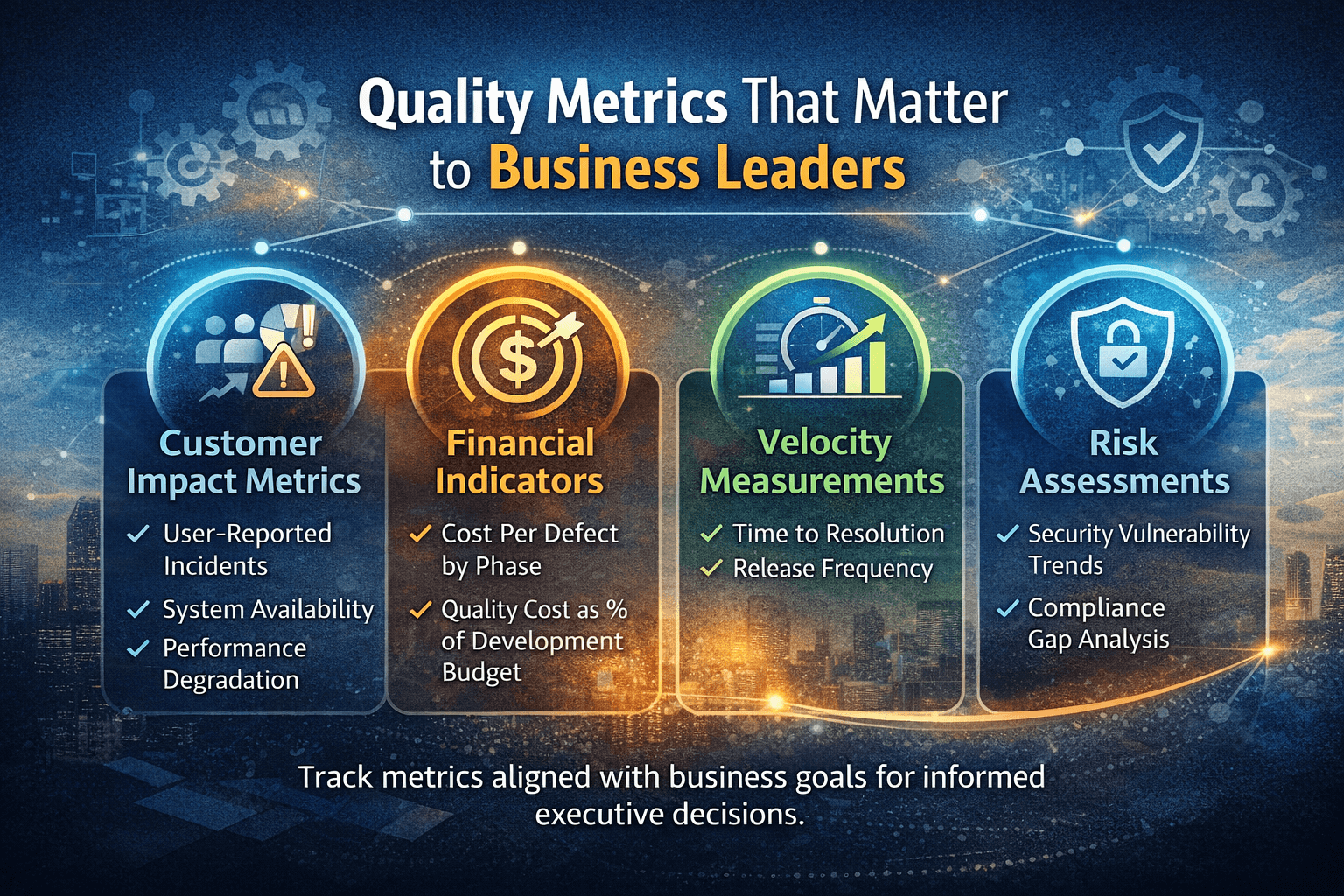
Quality Metrics That Matter to Business Leaders
Engineering teams often track detailed technical metrics—code coverage, defect density, mean time to resolution. While valuable for operational management, these metrics rarely resonate with business leadership. A strategic approach to software quality requires bridging this gap with business-aligned measurements:
- Customer impact metrics: user-reported incidents, system availability, performance degradation
- Financial indicators: cost per defect by phase, quality cost as percentage of development budget
- Velocity measurements: time from defect identification to resolution, release frequency
- Risk assessments: security vulnerability trends, compliance gap analysis
These business-oriented metrics enable informed decision-making at the executive level and justify quality investments in terms leadership understands.
Building a Quality-First Culture
Technology and processes alone cannot deliver sustainable quality improvements. Organizations seeing the greatest success treat quality as a cultural priority:
- Executive sponsorship that emphasizes quality in organizational goals and incentive structures
- Cross-functional collaboration between business, development, and QA teams
- Continuous learning with post-incident reviews focused on system improvement rather than blame
- Transparent communication about quality status and trade-offs
This cultural foundation transforms quality from a compliance checkbox into a competitive differentiator.
How Independent QA Partners Add Strategic Value
Many organizations underestimate the advantages of engaging independent software testing and quality assurance partners. The strategic value extends well beyond additional testing capacity.
Objective Perspective and Specialized Expertise
Internal development teams, regardless of their skill level, operate within organizational constraints and established patterns. Independent QA partners bring:
- Fresh perspective unencumbered by internal assumptions and biases
- Cross-industry experience applying lessons learned across diverse contexts
- Specialized capabilities in areas like security testing, performance engineering, or accessibility compliance
- Latest methodologies reflecting current best practices and emerging approaches
This external viewpoint often identifies risks and opportunities that internal teams, focused on delivery pressures, might overlook.
Scalability and Risk Management
Enterprise software initiatives face variable quality assurance demands throughout the lifecycle. Independent partners enable:
- Flexible capacity that scales with project needs without long-term hiring commitments
- Rapid team assembly with specialized skills for specific testing requirements
- Knowledge transfer that builds internal capability while leveraging external expertise
- Risk distribution through clear accountability and service-level agreements
Organizations like SQA.bg, with over 15 years of experience delivering independent software testing services, provide this strategic flexibility while maintaining consistent quality standards
Comprehensive Service Integration
Modern quality assurance extends beyond functional testing. Strategic QA partners offer integrated services including:
- Test automation to accelerate regression testing and enable continuous delivery
- DevOps integration connecting quality practices with deployment pipelines
- Business analysis ensuring requirements accurately reflect business needs
- Performance testing validating system behavior under realistic load conditions
This comprehensive approach addresses quality holistically rather than as isolated technical activities. Partners like SQA.bg combine software testing services with DevOps consulting and enterprise application development expertise, enabling seamless quality integration across the entire software lifecycle.
Proven Methodologies and Industry Standards
Independent QA providers bring established frameworks and compliance with recognized standards—critical for regulated industries and enterprise environments. Adherence to standards like IEEE 1012-1998 for Software Verification and Validation ensures:
- Systematic approaches that reduce variability and improve outcomes
- Clear documentation supporting audit requirements and knowledge transfer
- Best practice application refined through hundreds of client engagements
- Continuous improvement incorporating feedback and industry evolution
This methodological rigor provides confidence to stakeholders and reduces execution risk.
Conclusion: Quality as a Long-Term Business Strategy
The evidence is clear: software quality has evolved from a technical concern to a fundamental business strategy. Organizations that recognize this shift and act accordingly gain substantial competitive advantages—faster time-to-market, lower total cost of ownership, stronger customer relationships, and enhanced brand reputation.
Treating software quality strategically requires leadership commitment, cultural transformation, and often, strategic partnerships with specialized experts. The investment pays dividends that compound over time as quality improvements reduce technical debt, accelerate innovation, and strengthen market position.
For CTOs, CIOs, and business leaders evaluating their quality approach, the question isn’t whether to prioritize software quality—market dynamics have already made that decision. The real question is: how quickly can your organization make the transition from reactive quality management to proactive quality strategy?
As we explore in the coming articles in this series, building this capability involves people, processes, and technology working in concert. The journey begins with recognizing that software quality isn’t just what QA teams do—it’s how successful organizations compete.