
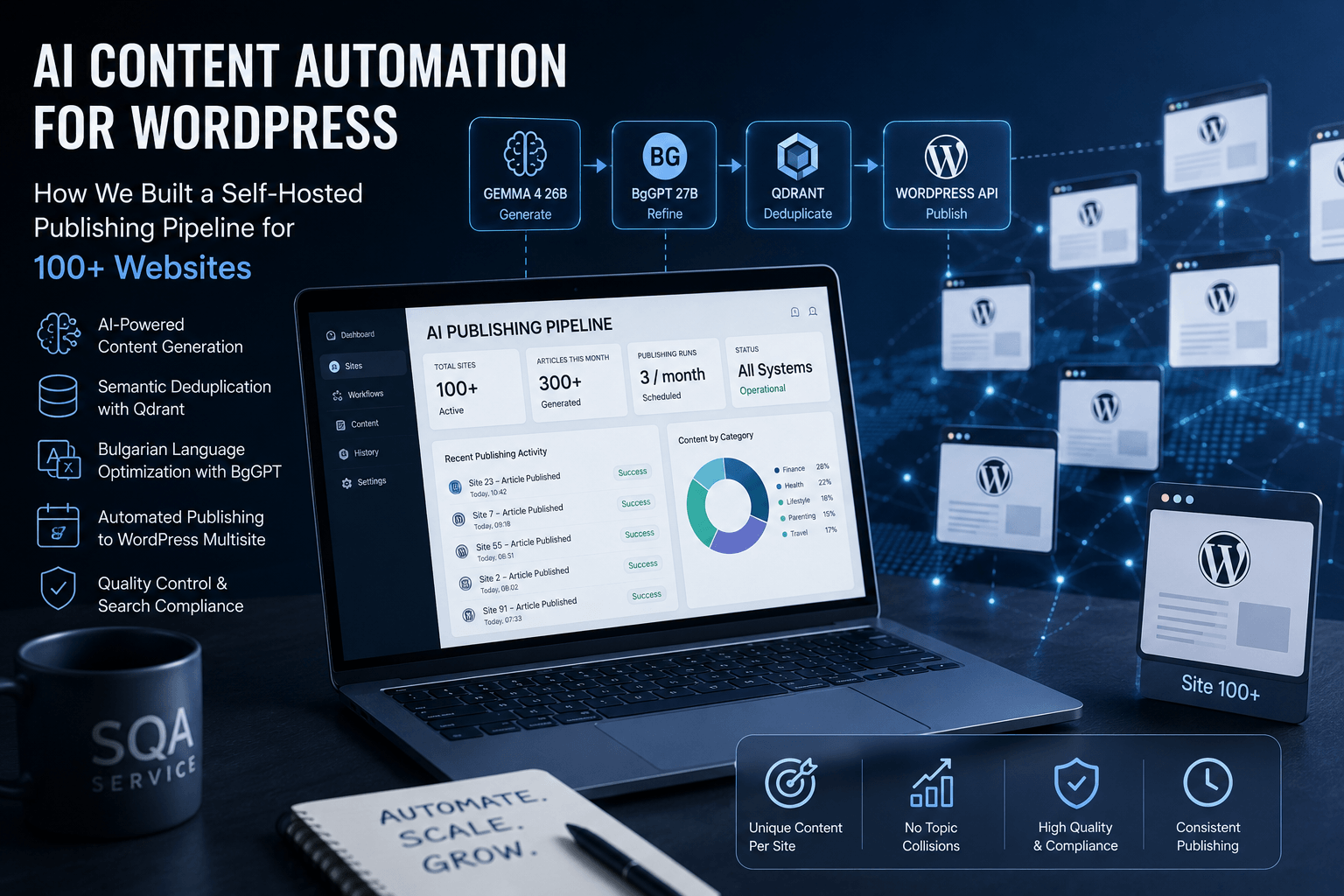
Managing content operations across a portfolio of more than 100 websites presents a massive operational challenge. Scaling this infrastructure manually demands unsustainable budgets for writers, editors, and content managers, while risking severe drops in editorial consistency and topic diversity.
When a leading digital marketing agency approached SQA Service Ltd, their WordPress Multisite network spanned over 100 niche websites, each targeting distinct industries and audiences.
Instead of building a generic “prompt-and-post” script that would trigger Google’s spam filters, we engineered a production-grade, self-hosted AI publishing pipeline. By combining local Large Language Models (LLMs), vector databases for semantic deduplication, and automated editorial safeguards, we successfully automated content operations while preserving the unique voice, quality, and search relevance required by modern search algorithms.
The Business Challenge: Scaling Without Triggering Search Penalties
As the client’s WordPress Multisite network expanded, manual content operations reached a breaking point. The agency faced three critical roadblocks:
- Unsustainable Operational Costs: Scaled content production using traditional copywriting frameworks was no longer financially viable.
- The “Cookie-Cutter” Risk: Generic AI tools write in a uniform style, which dilutes brand identity and violates Google’s helpful content guidelines regarding low-effort automation.
- Semantic Overlap: Across 100+ sites, human writers and basic automated systems frequently duplicate topics, destroying internal link structures and causing keyword cannibalization.
The objective was clear: Build an automated engine capable of driving consistent publishing schedules across 100+ distinct domains, ensuring that each piece of content remains original, contextually relevant, and linguistically flawless.
Solution Architecture & Technical Stack
To solve these challenges, we designed a multi-layered publishing platform built entirely on self-hosted infrastructure.
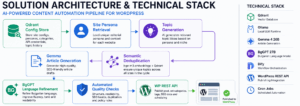
The Enterprise Technology Stack
| Component | Technology | Purpose |
| Local Model Serving | Ollama | Low-latency inference, zero per-token API costs./td> |
| Primary LLM | Gemma 4 26B | High-context article drafting and structuring. |
| Linguistic Refinement | BgGPT 27B | Dedicated Bulgarian natural language processing. |
| Vector Database | Qdrant | Persona repository, semantic memory, and history. |
| Embedding Model | bge-m3 | High-accuracy multilingual semantic vectorization. |
| Workflow Orchestration | Dify | Visual prompt engineering, versioning, and LLM ops. |
| CMS Integration | WordPress REST API | Programmatic content injection and scheduling. |
Architectural Deep Dive: Why Ollama, Qdrant, and Dify?
1. Ollama: Complete Infrastructure Control and Zero Token Costs
Relying on closed-source APIs (like OpenAI or Anthropic) for a network of this scale introduces volatile operational costs and data privacy concerns. By serving open-weight models locally through Ollama on client-managed infrastructure, we achieved:
- Predictable ROI: Fixed hardware costs instead of variable, compounding monthly API bills.
- Data Privacy: All proprietary prompt strategies, client data, and generated drafts remain securely inside the private infrastructure.
2. Qdrant: More Than a Vector Database
In this architecture, Qdrant does not merely execute basic vector searches. It serves as the central intelligence hub, acting as the:
- Dynamic Configuration Store: Maps specific configuration metrics to individual sites.
- Persona Repository: Stores vectorized content style guides for over 100 different niches.
- Semantic Anti-Collision Layer: Keeps an active historical memory of every topic generated across the entire network to prevent overlap.
3. Dify: Enterprise-Grade LLM Orchestration
Managing raw system prompts and multi-step inference chains across 100+ environments can quickly devolve into hard-to-maintain code. Dify provided a robust LLMOps environment, allowing our engineers to track prompt versioning, optimize context windows, and debug multi-model agent workflows without disrupting production cycles.
Advanced Persona Engineering: Eradicating the “AI Voice”
Google’s search algorithms easily detect generic AI content characterized by repetitive vocabulary and predictable structures. To counter this, we avoided a single “master prompt.”
Instead, we executed a comprehensive content audit of the client’s existing network to isolate:
- Target audience demographics and intent.
- Structural preferences (e.g., preference for short paragraphs, long-form guides, bulleted breakdowns).
- Specific brand constraints and localized jargon.
These parameters were converted into localized system prompts stored within Qdrant. When the pipeline triggers, the engine injects these hyper-specific persona files into the LLM context. As a result, an article generated for a personal finance site utilizes a completely different lexical profile, tone, and structural format than an article generated for a travel blog or a parenting portal.
Localized Optimization: Refining Bulgarian with BgGPT
A major pain point with major LLMs (like standard Llama or GPT variants) is their tendency to generate translated-sounding European languages. When generating Bulgarian content, standard models frequently output awkward literal translations, incorrect grammatical gender agreements, and robotic transitions.
To solve this, we introduced a two-step generation pipeline:
- The Blueprint Phase: A highly capable general LLM (Gemma) generates the core structure, facts, data points, and markdown formatting.
- The Refinement Phase: The raw draft is passed to BgGPT—a model explicitly trained on Bulgarian linguistic nuances. BgGPT performs a targeted editing pass, fixing localized syntax, polishing sentence flow, and ensuring natural phraseology without modifying the underlying factual data.
Solving the Multi-Site Overlap: Semantic Topic Deduplication
When managing over 100 domains, different site personas can naturally drift toward similar topic ideas during automated ideation phases.
To prevent cross-site keyword competition, we engineered an automated Semantic Deduplication Layer:
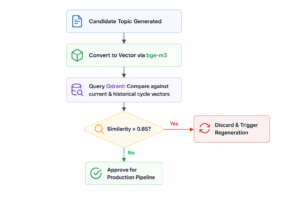
By enforcing this mathematical guardrail, cross-site topic collisions dropped to absolute zero, ensuring each domain maintains high topical authority without cannibalizing sister sites.
The Production Workflow: From Idle to Published
The entire pipeline is completely automated, running on a scheduled cron cadence.
- Profile Initialization: The orchestrator queries Qdrant to retrieve active site profiles and their corresponding persona vectors.
- Context Assembly: The system checks the WordPress REST API for recently published posts to establish a contextual baseline.
- Ideation & Filtering: The engine generates potential topic clusters, runs them through the bge-m3 embedding deduplication layer, and approves unique topics.
- Drafting & Refining: Gemma produces the foundational content markdown, which is immediately polished by BgGPT for native-level readability.
- Programmatic Validation: Automated scripts scan the output for anomalies, such as broken markdown syntax, empty sections, or repetitive phrases.
- CMS Injection: The finalized, fully-formatted article is pushed directly to the specific WordPress Multisite instance via the WP REST API as a scheduled draft.
Production Results & Impact
The platform has been operating continuously in production, transforming the client’s agency model from a resource-heavy editorial bottleneck into a streamlined, tech-driven content house.
- Scale in Action: 100+ active niche websites fully managed within a single unified infrastructure.
- Zero Network Overlap: Semantic deduplication successfully caught and blocked hundreds of potential duplicate content ideas before generation.
- Zero Per-Token Expenses: By self-hosting Ollama, Gemma, and BgGPT on dedicated hardware, the client avoided thousands of euro in monthly API costs.
- Google Compliance: Because the content focuses on high structural diversity, deep niche personalization, and accurate localization, the network maintains healthy organic visibility across search engine result pages (SERPs).
Key Lessons Learned
- AI Automation is an Engineering Challenge, Not a Prompting Challenge: Success at scale does not come from finding a “magic prompt.” It requires robust data validation, semantic memory layers, and error handling.
- Vector Databases are Multipurpose Infra: Qdrant proved to be an excellent tool for configuration caching, memory injection, and real-time deduplication simultaneously.
- Guardrails are Non-Negotiable: Pure automation without systemic validation layers inevitably fails. A production-grade pipeline must include continuous quality gates, automated linguistic checks, and structural audits.
FAQ
Does Google penalize content created via AI platforms?
No. Google’s official search quality guidelines explicitly state that content is evaluated based on its value, originality, and user utility (E-E-A-T), regardless of how it was produced. The platform is engineered specifically to avoid the low-quality, repetitive patterns that search engines flag as webspam.
Why go through the effort of self-hosting models instead of using OpenAI or Anthropic APIs?
Self-hosting provides absolute predictability over infrastructure overhead, prevents third-party data leakage, and ensures that the client is never subjected to sudden API pricing changes or model deprecations.
Can this architecture scale to other European languages?
Absolutely. The entire pipeline is language-agnostic. To adapt it for markets like Germany, Spain, or Romania, we simply hot-swap the localized embedding models and refinement LLMs while keeping the core Qdrant and Dify architecture completely intact.
Conclusion
Building a sustainable, high-volume AI automation pipeline requires moving away from fragile web scripts and embracing modern LLMOps. By coupling open-weight models with semantic memory engines and localized linguistic layers, SQA Service Ltd delivered a high-performance publishing engine that balances immense operational scale with strict editorial integrity.
If your enterprise operates a large-scale content network and needs to modernize its publishing workflows safely and efficiently, reach out to the AI engineering team at SQA Service Ltd to map out a tailored solution.
About SQA Service Ltd
SQA Service Ltd is an AI engineering, software quality assurance, and automation consultancy headquartered in Plovdiv, Bulgaria, with regional offices in Romania and Argentina. We design, validate, and scale enterprise AI integrations, reliable automated frameworks, and high-throughput data pipelines for global businesses.